
A Plain-English Guide by Techno Experts – With All the Technical Stuff You Actually Need
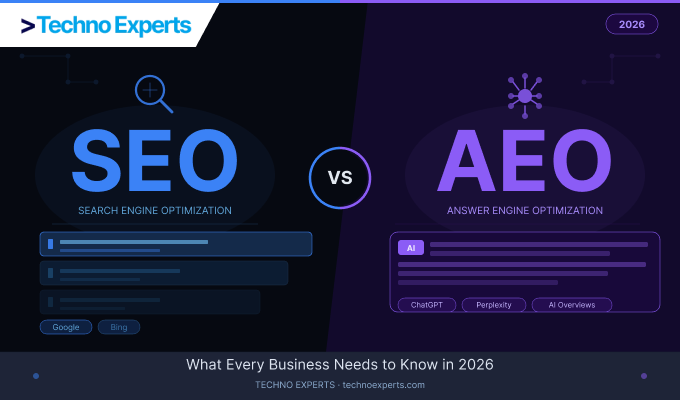
Quick Answer: SEO helps Google find you. AEO makes AI choose you. In 2026, you need both – and Techno Experts is here to show you exactly how.
Let’s Start With a Simple Question
When was the last time you Googled something and actually clicked a link?
If you’re like most people today, you probably just read the answer that popped up at the top – the one AI generated for you. No clicking. No scrolling. Just an instant answer.
That’s the world we’re living in now. And it’s changing everything about how businesses need to think about being found online.
At Techno Experts, we work with businesses every day who are putting all their energy into traditional Google rankings – and slowly becoming invisible. Not because they’re doing SEO wrong. But because they haven’t yet added the next layer: AEO.
This guide will walk you through both – in plain English, with real code examples you can actually use.
Table of Contents
- SEO: The Foundation That Still Matters
- AEO: The New Game Every Brand Must Play
- SEO vs AEO: What’s Actually Different?
- HTML Tags for SEO – The Complete List
- HTML Tags for AEO – What AI Engines Read
- Schema Markup: Your Secret Weapon
- Your Step-by-Step Implementation Checklist
- How to Measure Whether It’s Working
- The Techno Experts Strategy: Do Both, Win Both
1. SEO: The Foundation That Still Matters {#seo}
Let’s not overthink it. SEO (Search Engine Optimization) is simply the art and science of making your website easy for Google – and other search engines – to find, understand, and recommend.
Think of Google as a librarian. SEO is how you get your book properly labeled, shelved in the right section, and recommended when someone asks for it.
SEO works across four areas:
- On-Page SEO – The words, headings, and tags on your actual pages
- Technical SEO – How fast your site loads, how secure it is, how easy it is to crawl
- Off-Page SEO – Other websites linking to yours (backlinks = credibility votes)
- Local SEO – Getting found in your city or region
When SEO works, people search for something, see your page in the results, and click through to your site. That’s the model that’s been powering digital marketing for 20+ years.
Here’s the thing though – that model is cracking.
2. AEO: The New Game Every Brand Must Play {#aeo}
AEO (Answer Engine Optimization) is the practice of structuring your content so that AI-powered platforms – like ChatGPT, Perplexity, Google’s AI Overviews, and Microsoft Copilot – pick your content when generating an answer.
No click needed. Your brand name, your expertise, your answer – delivered directly to the user.
Here’s why this matters right now:
- Millions of people now go directly to ChatGPT or Perplexity instead of Google
- Google’s own AI Overviews now appear above organic rankings on most searches
- Voice assistants give ONE answer – and it needs to be yours
- Zero-click searches (where users get their answer without visiting any site) are now the majority for informational queries
The honest truth: If you only do SEO, you’re building a library nobody walks into anymore. AEO is how you get your answer spoken out loud in someone’s kitchen, quoted in a ChatGPT response, or shown at the top of a Google AI Overview.
Techno Experts Insight: SEO gets you ranked. AEO gets you chosen. Both matter. Neither is optional anymore.
3. SEO vs AEO: What’s Actually Different?
Here’s a side-by-side comparison that makes the distinction crystal clear:
| What We’re Comparing | SEO (Traditional) | AEO (AI-Powered) |
| Main Goal | Rank high in search results | Be cited in AI-generated answers |
| Who You’re Optimizing For | Google & Bing bots | ChatGPT, Perplexity, Google AI |
| Content Style | Long-form, comprehensive articles | Direct, conversational Q&A answers |
| Keyword Approach | “best project management software” | “What’s the best project management tool for remote teams?” |
| How You Win | Higher rankings = more clicks | Better structure = more AI citations |
| Trust Signal | Backlinks and domain authority | Author expertise, freshness, E-E-A-T |
| Top Schema Types | Organization, Product, Breadcrumb | FAQPage, HowTo, Speakable, QAPage |
| Measurement Tool | Google Search Console, Ahrefs | Peec AI, Profound, GA4 AI channels |
The bottom line: These aren’t enemies. They’re teammates. SEO is your foundation; AEO is your amplifier.
4. HTML Tags for SEO – The Complete List
Think of HTML tags as labels you put on your content so search engines understand it. Here are the ones that genuinely move the needle.
🔵 Title Tag – Your Single Most Important Tag
This is the headline that appears in search results. Get it right.
<title>Best Cloud Hosting Solutions for Small Businesses | Techno Experts</title>
Make it work:
- Keep it under 60 characters or Google will cut it off
- Put your main keyword near the front
- Add your brand name at the end
- Every page needs a unique title – no copy-pasting
🔵 Meta Description – Your Sales Pitch in 160 Characters
This doesn’t directly affect rankings, but it’s what convinces people to click.
<meta name=”description” content=”Explore Techno Experts’ top-rated cloud hosting plans. Lightning-fast speeds, 99.9% uptime, and 24/7 expert support. Start free today.” />
Make it work:
- Stay under 160 characters
- Include your keywords naturally – don’t stuff them
- End with a soft call to action
- Write it like a human, not a robot
🔵 Heading Tags (H1 to H6) – Your Content’s Skeleton
Headings tell Google what your page is actually about.
<h1>Best Cloud Hosting for Small Businesses in 2026</h1>
<h2>Shared Hosting vs VPS: Which Do You Need?</h2>
<h3>Shared Hosting: Pros and Cons</h3>
<h3>VPS Hosting: Pros and Cons</h3>
<h3>Questions to Ask Before You Buy</h3>
The rules:
- One <h1> per page – this is your main topic
- Never skip levels (don’t jump from H2 to H4)
- Use keywords in your H2s naturally
🔵 Canonical Tag – Stops Google From Getting Confused
If the same content appears at multiple URLs, this tag tells Google which one is the “real” one.
<link rel=”canonical” href=”https://www.technoexperts.co/cloud-hosting-guide/” />
🔵 Robots Meta Tag – Controls What Gets Indexed
<!– Show this page in search results (default) –>
<meta name=”robots” content=”index, follow” />
<!– Hide this page from search results –>
<meta name=”robots” content=”noindex, nofollow” />
Use noindex on admin pages, thank-you pages, and duplicate content you don’t want indexed.
🔵 Open Graph Tags – For Social Sharing
When your page gets shared on LinkedIn or Facebook, these tags control what preview appears.
<meta property=”og:title” content=”Cloud Hosting Guide 2026 | Techno Experts” />
<meta property=”og:description” content=”Everything you need to know about choosing cloud hosting in 2026.” />
<meta property=”og:image” content=”https://www.technoexperts.co/images/cloud-hosting-guide.jpg” />
<meta property=”og:url” content=”https://www.technoexperts.co/cloud-hosting-guide/” />
<meta property=”og:type” content=”article” />
<meta property=”og:site_name” content=”Techno Experts” />
🔵 Twitter Card Tags
<meta name=”twitter:card” content=”summary_large_image” />
<meta name=”twitter:title” content=”Cloud Hosting Guide 2026 | Techno Experts” />
<meta name=”twitter:description” content=”Expert breakdown of the best cloud hosting options this year.” />
<meta name=”twitter:image” content=”https://www.technoexperts.co/images/cloud-hosting-guide.jpg” />
<meta name=”twitter:site” content=”@TechnoExperts” />
🔵 Hreflang Tags – For Multiple Countries or Languages
If you serve customers in different countries or languages, this tag prevents confusion.
<link rel=”alternate” hreflang=”en-us” href=”https://www.technoexperts.co/en-us/” />
<link rel=”alternate” hreflang=”en-gb” href=”https://www.technoexperts.co/en-gb/” />
<link rel=”alternate” hreflang=”fr” href=”https://www.technoexperts.co/fr/” />
<link rel=”alternate” hreflang=”x-default” href=”https://www.technoexperts.co/” />
🔵 Image Alt Text – Accessibility + Image SEO
Every image should describe what it shows – for screen readers and image search.
<img src=”server-room.jpg” alt=”Techno Experts data center showing high-availability server racks” width=”800″ height=”450″ loading=”lazy”/>
🔵 Internal Links With Descriptive Text
The words you use in a link tell Google what the destination page is about.
<!– ✅ Right way –>
<a href=”/cloud-hosting-plans/”>explore Techno Experts cloud hosting plans</a>
<!– ❌ Wrong way –>
<a href=”/cloud-hosting-plans/”>click here</a>
5. HTML Tags for AEO – What AI Engines Read {#aeo-tags}
AI engines don’t just read keywords – they read meaning. These HTML5 semantic tags signal context, structure, and credibility to AI systems parsing your content.
🟠 Semantic Article Structure – Wrap Everything Properly
<article itemscope itemtype=”https://schema.org/Article”>
<header>
<h1 itemprop=”headline”>What Is AEO and Why Does Your Business Need It?</h1>
<time itemprop=”datePublished” datetime=”2026-03-01″>March 1, 2026</time>
<address itemprop=”author” itemscope itemtype=”https://schema.org/Person”>
Written by <span itemprop=”name”>Techno Experts Editorial Team</span>
</address>
</header>
<section itemprop=”articleBody”>
<!– Your content lives here –>
</section>
</article>
Why this matters: AI systems are trained to recognize <article> as a trustworthy, self-contained piece of content. It signals, “this is a real piece of writing, not navigation or advertising.”
🟠 Definition Blocks – AI Loves a Clear Answer
When AI engines encounter a question like “What is AEO?”, they look for the clearest, most direct definition. Give it to them on a silver platter.
<!– Using the <dfn> element –>
<p>
<dfn id=”aeo-definition”>Answer Engine Optimization (AEO)</dfn> is the practice of structuring your website content so AI-powered platforms – like ChatGPT, Perplexity, and Google AI Overviews – select and cite it when answering user questions.
</p>
Pro tip from Techno Experts: Your first paragraph on every page should answer the core question directly. Don’t bury the answer in paragraph five.
🟠 FAQ Structure With <details> and <summary>
This creates expandable Q&A sections that AI engines can easily extract.
<section aria-label=”Frequently Asked Questions”>
<h2>Your AEO Questions, Answered</h2>
<details>
<summary>What is the difference between SEO and AEO?</summary>
<p>SEO helps search engines rank your page. AEO helps AI engines choose your content as a direct answer. SEO drives traffic through clicks; AEO drives visibility through citations – even when no click happens.</p>
</details>
<details>
<summary>How quickly does AEO show results?</summary>
<p>Once AI platforms crawl your updated, structured content, you can
start appearing in AI-generated answers within days – often much faster
than traditional SEO ranking improvements.</p>
</details>
<details>
<summary>Do I need to choose between SEO and AEO?</summary>
<p>Never. They work together. Think of SEO as building the road and AEO
as putting up the signs. You need both for people – and AI – to find you.</p>
</details>
</section>
🟠 Step-by-Step Instructions – For How-To Content
<section aria-label=”How To”>
<h2>How to Set Up AEO on Your Website: Step by Step</h2>
<ol>
<li>
<strong>Audit your existing content</strong> – Find your top pages
and identify which ones already answer common questions in your niche.
</li>
<li>
<strong>Rewrite introductions</strong> – Lead every page with a direct
one-sentence answer to the main question the page addresses.
</li>
<li>
<strong>Add FAQ sections</strong> – Include 3–5 Q&A pairs on every
informational page, using real questions your customers ask.
</li>
<li>
<strong>Implement schema markup</strong> – Add FAQPage, Article, and
HowTo JSON-LD to your pages (full examples below).
</li>
<li>
<strong>Monitor AI citations</strong> – Set up GA4 to track traffic
from AI platforms like ChatGPT and Perplexity.
</li>
</ol>
</section>
🟠 Speakable Sections – Optimized for Voice Search
Tag the sections of your page best suited for voice assistants to read aloud.
<section id=”quick-answer” class=”speakable” aria-label=”Quick Answer”>
<h2>The Short Answer</h2>
<p>AEO is how you make AI engines like ChatGPT and Google AI Overviews
cite your brand. It works alongside SEO – not instead of it.
Together, they ensure you’re found no matter how someone searches.</p>
</section>
🟠 Author & Date Metadata – Proving You’re the Expert
AI engines care deeply about who wrote something and when. This signals freshness and authority.
<head>
<meta name=”author” content=”Techno Experts Editorial Team” />
<meta name=”article:published_time” content=”2026-03-01T09:00:00+00:00″ />
<meta name=”article:modified_time” content=”2026-03-13T12:00:00+00:00″ />
<link rel=”author” href=”https://www.technoexperts.co/about/our-team/” />
</head>
🟠 Breadcrumb Navigation – Context for AI and Users
<nav aria-label=”Breadcrumb”>
<ol>
<li><a href=”/”>Home</a></li>
<li><a href=”/digital-marketing/”>Digital Marketing</a></li>
<li><a href=”/seo-guides/”>SEO Guides</a></li>
<li aria-current=”page”>SEO vs AEO 2026</li>
</ol>
</nav>
6. Schema Markup: Your Secret Weapon {#schema}
If HTML tags are road signs, schema markup is the GPS system – it tells AI engines not just where your content is, but what it means and why it matters.
Always use JSON-LD format, placed inside a <script> tag. It’s cleaner, easier to maintain, and Google prefers it.
⭐ FAQPage Schema – #1 Priority for AEO
This is the single most powerful schema for getting cited in AI-generated answers. Add it to every page with Q&A content.
<script type=”application/ld+json”>
{
“@context”: “https://schema.org”,
“@type”: “FAQPage”,
“mainEntity”: [
{
“@type”: “Question”,
“name”: “What is Answer Engine Optimization (AEO)?”,
“acceptedAnswer”: {
“@type”: “Answer”,
“text”: “AEO (Answer Engine Optimization) is the process of structuring website content so that AI-powered platforms like ChatGPT, Perplexity, and Google AI Overviews select and display it as a direct answer. Unlike SEO, which targets search rankings, AEO targets AI citations.”
}
},
{
“@type”: “Question”,
“name”: “How is AEO different from SEO?”,
“acceptedAnswer”: {
“@type”: “Answer”,
“text”: “SEO (Search Engine Optimization) focuses on ranking pages in Google and Bing to generate click-through traffic. AEO (Answer Engine Optimization) focuses on ensuring AI systems choose your content when generating answers, providing brand visibility even without a user clicking your link.”
}
},
{
“@type”: “Question”,
“name”: “Does Techno Experts offer AEO services?”,
“acceptedAnswer”: {
“@type”: “Answer”,
“text”: “Yes. Techno Experts provides full-service AEO implementation including content restructuring, schema markup, E-E-A-T optimization, and AI citation tracking. Our team helps businesses appear in AI-generated answers across ChatGPT, Perplexity, and Google AI Overviews.”
}
}
]
}
</script>
⭐ HowTo Schema – For Step-by-Step Guides
<script type=”application/ld+json”>
{
“@context”: “https://schema.org”,
“@type”: “HowTo”,
“name”: “How to Optimize Your Website for AI Answer Engines”,
“description”: “A beginner-friendly guide from Techno Experts on implementing AEO for your business website in 2026.”,
“totalTime”: “PT3H”,
“estimatedCost”: {
“@type”: “MonetaryAmount”,
“currency”: “USD”,
“value”: “0”
},
“step”: [
{
“@type”: “HowToStep”,
“position”: 1,
“name”: “Audit Your Top Pages”,
“text”: “Identify your 10 most visited pages. Check which ones already answer common customer questions and which need restructuring.”,
“url”: “https://www.technoexperts.co/aeo-guide/#step1”
},
{
“@type”: “HowToStep”,
“position”: 2,
“name”: “Rewrite Introductions to Lead With Answers”,
“text”: “For every informational page, make sure the very first paragraph gives a direct, clear answer to the main question the page addresses.”,
“url”: “https://www.technoexperts.co/aeo-guide/#step2”
},
{
“@type”: “HowToStep”,
“position”: 3,
“name”: “Add FAQ Sections”,
“text”: “Add 3–5 real customer questions and direct answers to every key page. Use <details> and <summary> HTML tags for clean formatting.”,
“url”: “https://www.technoexperts.co/aeo-guide/#step3”
},
{
“@type”: “HowToStep”,
“position”: 4,
“name”: “Implement Schema Markup”,
“text”: “Add FAQPage and Article JSON-LD schema to all updated pages. Validate using Google’s Rich Results Test tool before publishing.”,
“url”: “https://www.technoexperts.co/aeo-guide/#step4”
},
{
“@type”: “HowToStep”,
“position”: 5,
“name”: “Track AI Referral Traffic”,
“text”: “Set up a custom channel group in Google Analytics 4 to monitor traffic from AI platforms like ChatGPT, Perplexity, and Bing Copilot.”,
“url”: “https://www.technoexperts.co/aeo-guide/#step5”
}
]
}
</script>
⭐ Article / TechArticle Schema – Builds Author Trust
This is how you prove to AI engines that a real, qualified expert wrote your content.
<script type=”application/ld+json”>
{
“@context”: “https://schema.org”,
“@type”: “TechArticle”,
“headline”: “SEO vs AEO: The Complete 2026 Guide for Businesses”,
“description”: “Techno Experts breaks down the difference between SEO and AEO – including HTML tags, schema markup, and a step-by-step implementation checklist for 2026.”,
“image”: “https://www.technoexperts.co/images/seo-vs-aeo-2026.jpg”,
“datePublished”: “2026-03-01”,
“dateModified”: “2026-03-13”,
“author”: {
“@type”: “Organization”,
“name”: “Techno Experts”,
“url”: “https://www.technoexperts.co”,
“sameAs”: [
“https://linkedin.com/company/technoexperts”,
“https://twitter.com/TechnoExperts”
]
},
“publisher”: {
“@type”: “Organization”,
“name”: “Techno Experts”,
“logo”: {
“@type”: “ImageObject”,
“url”: “https://www.technoexperts.co/logo.png”
}
},
“mainEntityOfPage”: {
“@type”: “WebPage”,
“@id”: “https://www.technoexperts.co/seo-vs-aeo-guide/”
},
“keywords”: [“SEO”, “AEO”, “Answer Engine Optimization”, “AI search 2026”, “schema markup”, “Techno Experts”],
“articleSection”: “Digital Marketing”
}
</script>
⭐ Speakable Schema – Voice Search Visibility
Tell Google Assistant and smart speakers which parts of your page to read aloud.
<script type=”application/ld+json”>
{
“@context”: “https://schema.org”,
“@type”: “WebPage”,
“name”: “SEO vs AEO Guide 2026 | Techno Experts”,
“speakable”: {
“@type”: “SpeakableSpecification”,
“cssSelector”: [
“#quick-answer”,
“#aeo-definition”,
“.speakable”
]
},
“url”: “https://www.technoexperts.co/seo-vs-aeo-guide/”
}
</script>
⭐ Organization Schema – Your Brand’s Identity Card
Put this in the <head> of every page on your site. It tells AI engines who you are.
<script type=”application/ld+json”>
{
“@context”: “https://schema.org”,
“@type”: “Organization”,
“name”: “Techno Experts”,
“url”: “https://www.technoexperts.co”,
“logo”: “https://www.technoexperts.co/logo.png”,
“description”: “Techno Experts is a technology and digital marketing company helping businesses grow their online presence through SEO, AEO, web development, and AI-ready content strategies.”,
“foundingDate”: “2015”,
“sameAs”: [
“https://linkedin.com/company/technoexperts”,
“https://twitter.com/TechnoExperts”,
“https://youtube.com/technoexperts”,
“https://facebook.com/TechnoExperts”
],
“contactPoint”: {
“@type”: “ContactPoint”,
“contactType”: “customer support”,
“email”: “hello@technoexperts.com”,
“availableLanguage”: “English”
}
}
</script>
⭐ BreadcrumbList Schema – Navigation Context
<script type=”application/ld+json”>
{
“@context”: “https://schema.org”,
“@type”: “BreadcrumbList”,
“itemListElement”: [
{
“@type”: “ListItem”,
“position”: 1,
“name”: “Home”,
“item”: “https://www.technoexperts.co/”
},
{
“@type”: “ListItem”,
“position”: 2,
“name”: “Digital Marketing”,
“item”: “https://www.technoexperts.co/digital-marketing/”
},
{
“@type”: “ListItem”,
“position”: 3,
“name”: “SEO vs AEO Guide”,
“item”: “https://www.technoexperts.co/seo-vs-aeo-guide/”
}
]
}
</script>
⭐ QAPage Schema – For Community Questions
If your site has a blog comments section, forum, or Q&A page, use this.
<script type=”application/ld+json”>
{
“@context”: “https://schema.org”,
“@type”: “QAPage”,
“mainEntity”: {
“@type”: “Question”,
“name”: “Should I invest in AEO or stick with SEO in 2026?”,
“text”: “I’ve been doing SEO for years and my rankings are good. Is it worth switching focus to AEO?”,
“answerCount”: 1,
“upvoteCount”: 214,
“dateCreated”: “2026-02-10”,
“author”: {
“@type”: “Person”,
“name”: “Sarah M.”
},
“acceptedAnswer”: {
“@type”: “Answer”,
“text”: “You shouldn’t switch – you should layer. Your SEO foundation is valuable and still drives real traffic. AEO is not a replacement; it’s the next floor you build on top. Start by adding FAQPage schema to your top 10 pages, restructure your intros to lead with direct answers, and monitor how your brand shows up in ChatGPT and Perplexity. You’ll likely see AI citation appearances within weeks.”,
“upvoteCount”: 189,
“dateCreated”: “2026-02-10”,
“author”: {
“@type”: “Organization”,
“name”: “Techno Experts”
}
}
}
}
</script>
⭐ Product Schema – If You Sell Something
<script type=”application/ld+json”>
{
“@context”: “https://schema.org”,
“@type”: “Product”,
“name”: “Techno Experts AEO Starter Package”,
“description”: “Full AEO setup for your business website – includes content audit, schema implementation, FAQ restructuring, and AI citation monitoring.”,
“brand”: {
“@type”: “Brand”,
“name”: “Techno Experts”
},
“offers”: {
“@type”: “Offer”,
“price”: “499.00”,
“priceCurrency”: “USD”,
“availability”: “https://schema.org/InStock”,
“url”: “https://www.technoexperts.co/services/aeo/”
},
“aggregateRating”: {
“@type”: “AggregateRating”,
“ratingValue”: “4.9”,
“reviewCount”: “128”,
“bestRating”: “5”
}
}
</script>
7. Your Step-by-Step Implementation Checklist {#checklist}
Don’t let perfect be the enemy of done. Start here and work your way through systematically.
✅ SEO Foundation – Do These First
- <title> tag – Unique, keyword-rich, under 60 characters on every page
- <meta name=”description”> – Compelling, 150–160 characters, every page
- One <h1> per page with your primary keyword
- Logical H2–H6 heading hierarchy throughout
- <link rel=”canonical”> on all indexable pages
- XML Sitemap submitted to Google Search Console and Bing Webmaster Tools
- robots.txt configured correctly
- HTTPS enabled site-wide
- Core Web Vitals passing: LCP < 2.5s, FID < 100ms, CLS < 0.1
- Mobile-responsive on all screen sizes
- Alt text on every image
- Open Graph tags on all shareable pages
- Hreflang tags for multilingual audiences
- Internal linking using descriptive anchor text
- Breadcrumb navigation in place
✅ AEO Layer – Build on Top
- FAQPage JSON-LD schema on every Q&A page
- TechArticle/Article schema with author and publisher details
- Organization schema in site <head> (sitewide)
- BreadcrumbList schema on all pages
- Speakable schema referencing your “quick answer” sections
- HowTo schema on all step-by-step content
- QAPage schema on forum or community content
- Product schema with AggregateRating on service/product pages
- First paragraph of every page = direct answer to the main question
- H2/H3 subheadings phrased as real user questions
- Semantic HTML5 elements used throughout (<article>, <section>, <details>)
- datePublished and dateModified kept current on all content
- Author bio pages with credentials linked from articles
- External citations linking to credible sources (studies, .gov, .edu)
8. How to Measure Whether It’s Working {#metrics}
SEO – What You’re Tracking
| Metric | Where to Find It |
| Keyword rankings | Google Search Console, Ahrefs, SEMrush |
| Organic traffic | Google Analytics 4 |
| Click-through rate (CTR) | Google Search Console |
| Core Web Vitals | PageSpeed Insights |
| Backlink growth | Ahrefs, Moz |
AEO – The New Metrics That Matter
| Metric | Where to Find It |
| AI Overview appearances | Peec AI, Profound |
| Featured snippet ownership | SEMrush, Ahrefs |
| AI referral traffic | Google Analytics 4 (custom channel) |
| Brand mentions in ChatGPT | Manual testing monthly |
| Voice search visibility | Manual testing + AEO audit tools |
| Zero-click impression share | Google Search Console |
📊 Setting Up AI Traffic Tracking in GA4 (Step by Step)
- Go to Admin → Data Streams → Configure tag settings
- Click Channel Groups → Create new channel group
- Add these domains as sources:
- chat.openai.com (ChatGPT)
- perplexity.ai
- bing.com/chat (Copilot)
- gemini.google.com
- Name the group “AI Platforms”
- Monitor sessions, conversions, and revenue from this channel monthly
9. The Techno Experts Strategy: Do Both, Win Both {#strategy}
Here’s the picture we want you to walk away with:
A user asks a question
│
▼
┌────────────────────────┐
│ GOOGLE / BING (SEO Layer) │
│ Your content is crawled, indexed, │
│ and ranked → Organic click traffic │
└──────────────────┬─────┘
│
▼
┌────────────────────────────┐
│ CHATGPT / PERPLEXITY / AI OVERVIEWS │
│ (AEO Layer) │
│ Your content is selected, cited, │
│ and delivered → Brand visibility │
└─────────────────────────────────────────┘
Without SEO, AI engines can’t find or trust your content. Without AEO, your content ranks but never gets cited. With both, you win at every point of the user journey.
The Three-Phase Techno Experts Approach
Phase 1 – Build the Foundation (Weeks 1–4) Fix your technical SEO first. Fast, secure, mobile-friendly websites are the price of admission. AI models are trained on what humans prefer – and humans prefer sites that load quickly and work well on phones.
Phase 2 – Layer on AEO (Weeks 5–8) Take your best-performing SEO pages and restructure them for AI. Add FAQ sections. Lead with direct answers. Implement schema. Tag speakable sections. Keep author and date metadata fresh.
Phase 3 – Measure, Update, Repeat (Ongoing) Track AI referral traffic in GA4. Manually ask ChatGPT and Perplexity about your industry monthly – does your brand come up? Refresh content every quarter. The brands winning at AEO right now are the ones treating freshness as a non-negotiable.
Quick Reference: Which Schema Goes on Which Page?
| Your Page Type | Must-Have Schema |
| Blog Article | Article + FAQPage + BreadcrumbList |
| How-To Guide | HowTo + Article + FAQPage |
| Service Page | Product/Service + FAQPage + BreadcrumbList |
| Home Page | Organization + WebSite + Speakable |
| Team/Author Bio | Person + ProfilePage |
| Forum or Q&A | QAPage |
| Video Content | VideoObject + Article |
| Local Business | LocalBusiness + FAQPage |
| Webinar/Event | Event + Organization |
Final Word From Techno Experts
The businesses that will dominate search in 2026 and beyond aren’t choosing between SEO and AEO. They’re doing both – and treating them as two floors of the same building.
SEO gets you on the map. AEO makes you the answer.
Whether you’re a startup just building your first site or an established brand looking to stay ahead of the AI search curve, Techno Experts is here to help you build a strategy that performs – on Google, on ChatGPT, and everywhere in between.
