
Business Growth Strategy: From Idea to Sustainable Success
A business growth strategy is a structured plan that connects a business idea to market execution and long-term scale – covering discovery, planning, execution, and post-launch optimisation as a continuous loop, not a one-time event.
You’ve had the idea. Maybe it came to you at 2 a.m., maybe it’s been sitting in a notes app for two years, or maybe you just got fed up with how badly an existing product solved your problem. Wherever it came from, here’s the truth nobody tells you at the “idea” stage: the idea was never the hard part.
What actually separates the businesses that grow from the ones that quietly fade out isn’t a better idea. It’s a better business growth strategy – a real plan that connects vision to execution, and execution to scale.
We’ve sat across the table from enough founders to know this pattern by heart. Someone walks in with a genuinely great idea and a long list of questions: Where do we even start? What do we build first? How do we know if it’s working? Over time, we’ve narrowed our answer down to a four-stage approach that keeps showing up, project after project, as the thing that actually works.
Let’s walk through it.
Why a Great Idea Still Needs a Business Growth Strategy
A great idea still needs a business growth strategy because ideas alone don’t create momentum – the discipline to validate, plan, and build systematically is what separates businesses that scale from ones that stall.
Here’s a slightly uncomfortable fact: ideas are cheap. Not in a dismissive way – a good idea genuinely matters – but in the sense that almost every industry is full of smart people with smart ideas. What’s rare is the discipline to turn that idea into something the market actually wants, built in a way that can grow without falling over.
Most businesses that stall don’t stall because the idea was wrong. They stall because there was no roadmap linking the idea to the market, no data behind the early decisions, and no system ready to handle growth once it actually showed up. A strategy isn’t bureaucracy. It’s the thing that keeps a good idea from dying of neglect.
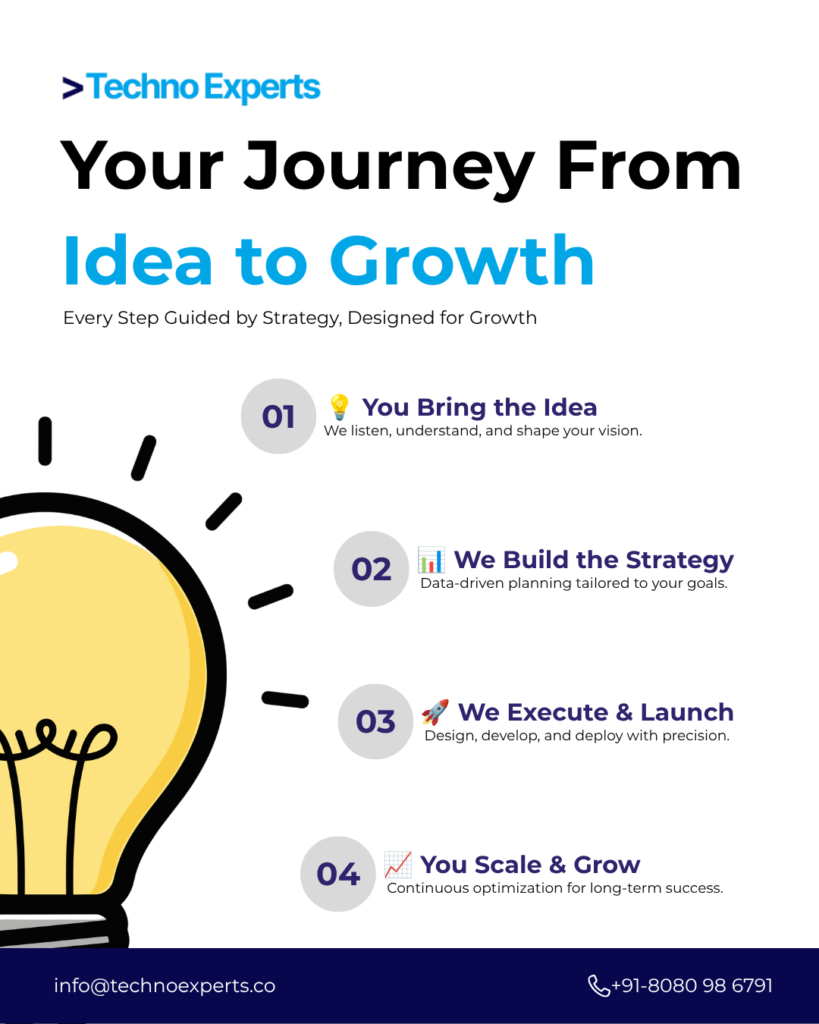
So what does that strategy actually look like, step by step?
The 4-Stage Business Growth Strategy at a Glance
- Discover – Listen before you build. Define goals, audience, and constraints.
- Plan – Ground the vision in keyword research, tech decisions, and measurable KPIs.
- Execute – Build design, development, performance, infrastructure, and security in alignment.
- Grow – Treat launch as day one: SEO, automation, iteration, and market expansion.
Step 1: Start With Listening, Not Building
The first step in a business growth strategy is discovery – understanding what success looks like, who the product is for, where the competitive gap exists, and what constraints the business is working within, before a single wireframe is drawn.
Every project we’ve ever worked on that went well started the same way – with a conversation, not a contract. Before any strategy document gets written or a single wireframe gets sketched, the real first step is understanding what you’re actually trying to build and why.
That usually means digging into a few honest questions:
- What does success actually look like for you – in 6 months, in a year, in three?
- Who is this really for, and what specific problem are you solving for them?
- Who else is already in this space, and where’s the gap you can own?
- What are you working with – budget, time, team, technical limits?
It’s tempting to skip this and jump straight to building. Don’t. Every later decision – design choices, the tech stack, the marketing angle – inherits whatever assumptions get made here. Get this part wrong, and you’re optimising for the wrong target the whole way through.
Step 2: Turn the Vision Into a Data-Backed Plan
Turning a vision into a plan means replacing gut-feeling assumptions with keyword research, competitive analysis, a defined technology stack, a unified go-to-market timeline, and KPIs that make progress visible and measurable.
Once there’s clarity on the “why,” the next job is building a strategy that’s grounded in evidence rather than gut feeling. This is the stage where a lot of businesses quietly go off track, often without realising it until much later.
A strategy that’s actually worth the name usually covers:
- Real keyword and market research – not guessing what people search for, but checking, so the content and SEO work has a foundation
- A technology decision that fits the business, whether that’s a fully custom build or a flexible platform like WordPress that won’t box you in later
- A go-to-market timeline that lines up design, development, and marketing instead of treating them as separate projects
- Metrics that mean something – so progress is something you can point to, not just something you feel
A strategy without data isn’t really a strategy. It’s an opinion wearing a deadline. The businesses that grow consistently are the ones willing to let evidence – not assumptions – drive the early calls.
Step 3: Execute With Precision, Not Just Speed
Precise execution means building conversion-focused design, production-grade development, optimised Core Web Vitals performance, reliable server infrastructure, and baked-in security – all in alignment with the strategy, not as independent workstreams.
This is the part everyone’s excited about – the idea finally becomes something real. A working site, an app, a platform people can actually click around in. But this is also where a lot of good strategies fall apart, because execution gets treated as “just build it” instead of “build it to plan.”
Solid execution usually touches all of the following:
- Design that doesn’t just look good but actually moves visitors toward becoming customers – this is the core of website design
- Development built to hold up under real traffic and real users, not just a demo – covered in our website development work
- Speed and performance, including Core Web Vitals optimisation, because a slow site quietly loses customers no one ever complains about
- Reliable infrastructure, through proper server setup and management, so things don’t break the moment traffic spikes
- Security baked in from the start, not patched on later – see data security and protection
A gorgeous site that takes six seconds to load and a fast site nobody can navigate fail for the exact same reason: execution that lost sight of the strategy behind it. Speed matters, but precision matters more.
Step 4: Treat Launch as the Starting Line, Not the Finish Line
After launch, sustainable business growth requires ongoing SEO, social media marketing, sales and marketing automation, data-driven product iteration, and multilingual expansion – because growth compounds when optimisation becomes a habit, not a one-time event.
Here’s where a lot of businesses get it wrong: they treat launch day like the end of the project. In reality, it’s closer to day one of the part that actually determines whether the business grows or plateaus.
Sustainable growth after launch tends to involve:
- Ongoing SEO work, so organic traffic keeps building instead of every customer costing an ad dollar
- Social media marketing to build an actual audience and brand presence, not just a logo with a follower count
- Marketing and sales automation, like our Sales and Marketing Automation Suite, so leads get nurtured instead of falling through the cracks
- Real iteration based on real data – watching how people actually use the product and adjusting, instead of guessing
- Getting ready for new markets, including tools like AI Language Translation when it’s time to grow beyond your first audience
Growth compounds when optimisation becomes a habit, not a one-time event you tackle right after launch and then forget about. The businesses that plateau are almost always the ones that stopped iterating the moment the site went live.
The Thread That Connects All Four Stages
The four stages of a business growth strategy – discovery, planning, execution, and post-launch growth – only work when they are connected: each stage inherits its inputs from the one before it, and the gaps between stages are where most businesses lose momentum.
None of these four stages work well in isolation. Skip the listening stage, and your strategy is built on assumptions. Skip the strategy, and execution has nothing to aim at. Skip the post-launch optimisation, and growth stalls right where it should be accelerating.
What ties it all together is partnership. Most of the businesses that lose momentum don’t lose it because any single stage failed outright – they lose it in the gaps between stages, where the strategy team and the dev team aren’t talking, or where nobody owns what happens after launch. A good growth strategy isn’t just four steps. It’s making sure nothing falls through the cracks between them.
Business Growth Strategy: Frequently Asked Questions
What is the first step in building a business growth strategy?
The first step is discovery: having structured conversations to define what success looks like, who the product serves, where the competitive gap exists, and what budget, time, and technical constraints apply – before writing a single strategy document or wireframe.
How long does it take to execute a business growth strategy?
The initial build and launch phase typically spans 60–120 days depending on scope. However, a growth strategy is ongoing – SEO, automation, and iteration continue indefinitely after launch, compounding results over 6, 12, and 36-month horizons.
What is the difference between a business strategy and a growth strategy?
A business strategy defines what a company does and how it operates. A business growth strategy specifically focuses on how the company expands – acquiring new customers, entering new markets, scaling revenue, and building systems that can handle increasing demand without breaking.
Why do most businesses fail to scale after launch?
Most businesses fail to scale after launch because they stop iterating. They invest in the launch but not in post-launch SEO, automation, or data-driven optimisation. Growth requires treating launch as day one, not as the finish line.
So, What’s Actually Stopping You?
If you ask most founders what the hardest part of building a business really is, it’s rarely “I ran out of ideas.” It’s the gap between having a vision and having a working, scalable system that turns that vision into results.
If you’re holding an idea right now and trying to figure out what comes next – whether that’s proper market research, a website that actually converts, an SEO plan that compounds over time, or a full digital overhaul – that gap is exactly where the right strategy and the right partner make the difference between a project that fizzles and a business that grows.
Have an idea you’re ready to build on? Talk to our team and let’s map out what it actually takes to get there.
