
5 Signs Your Website Needs a Redesign (And What to Do About Each One)
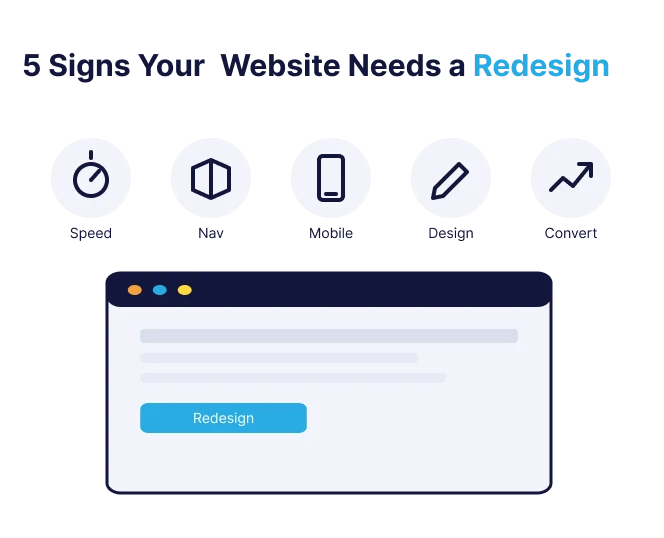
The five most common signs a website needs a redesign are slow loading speed, confusing navigation, poor mobile design, an outdated visual appearance, and a low conversion rate – each one quietly costing businesses customers before they ever realise something is wrong.
Most businesses don’t notice their website has a problem until it’s already costing them customers. There’s no alarm bell that goes off when a visitor leaves because the page took too long to load, or when someone gives up trying to find your contact page and just calls a competitor instead.
If you’re asking yourself whether your website needs a redesign, that question alone is usually a sign worth paying attention to. Below are the five most common signals we see when working with businesses whose websites have quietly fallen behind – along with what each one actually means for your bottom line, and how to fix it.
5 Signs Your Website Needs a Redesign – At a Glance
- Slow loading speed – pages taking more than 2–3 seconds to load are losing visitors silently
- Confusing navigation – visitors can’t find what they need within a few seconds and leave
- Poor mobile design – broken layouts and hard-to-tap elements hurt both users and SEO rankings
- Outdated design – a dated visual appearance signals an untrustworthy or inactive business
- Low conversion rate – traffic is arriving but not turning into leads, sign-ups, or customers
1. Slow Loading Speed
A slow-loading website is one of the clearest signs a redesign is needed – as page load time increases from one second to five seconds, the probability of a visitor bouncing rises sharply, meaning every extra second of delay is directly costing you potential customers.
Research from Google has consistently shown that as page load time increases from one second to five seconds, the probability of a visitor bouncing rises sharply. In other words, every extra second your site takes to load is a second where you’re quietly losing potential customers – and they never even tell you why they left.
Common causes of slow loading speed include:
- Unoptimised, oversized images
- Bloated themes or excessive plugins (especially common on older WordPress sites)
- Poor hosting infrastructure
- No caching or content delivery network (CDN) in place
- Render-blocking scripts that delay the page from becoming usable
The fix: A proper website redesign isn’t just about visuals – it’s an opportunity to rebuild the site’s technical foundation. That includes image optimisation, clean code, modern hosting, and attention to Core Web Vitals, the performance metrics Google uses to evaluate user experience and rank websites.
2. Confusing Navigation
Confusing navigation is one of the most common – and most fixable – signs a website needs a redesign: if visitors can’t find what they need within a few seconds of landing, they leave, and that lost traffic never shows up in any report.
If a visitor lands on your website and can’t figure out where to click within a few seconds, you’ve likely already lost them. Confusing navigation is one of the most common – and most fixable – reasons websites underperform.
Signs your navigation needs work:
- Menu items that don’t clearly describe what’s behind them
- Too many options crammed into the main menu
- No clear path to the page that actually matters (contact, pricing, services)
- Visitors needing more than 2–3 clicks to reach key information
Good navigation isn’t about being clever – it’s about being obvious. Visitors shouldn’t have to think about how to find what they’re looking for.
The fix: A redesign gives you the chance to rethink your site’s structure from a visitor’s perspective rather than an internal, org-chart perspective. This is core to good website design – building an information architecture around what your audience actually wants to do, not just what your business wants to say.
3. Poor Mobile Design
Poor mobile design is a critical sign a website needs a redesign because more than half of all global web traffic now comes from mobile devices, and Google uses mobile-first indexing – meaning a broken mobile experience directly hurts both user satisfaction and search rankings.
More than half of all web traffic globally now comes from mobile devices, and for many industries that number is significantly higher. If your website wasn’t built mobile-first – or worse, if it was only adapted for mobile as an afterthought – you’re likely losing the majority of your potential audience before they even get a chance to engage.
Common mobile design problems include:
- Text that’s too small to read without zooming
- Buttons and links placed too close together to tap accurately
- Layouts that break or overlap on smaller screens
- Forms that are painful to fill out on a touchscreen
- Pages that load even slower on mobile networks than on desktop
Google also primarily uses mobile-first indexing, which means the mobile version of your site is what determines your search rankings – not the desktop version. A poor mobile experience doesn’t just frustrate users; it actively hurts your SEO.
The fix: A redesign should be approached mobile-first, not mobile-adjusted. That means designing the mobile experience as the primary version of your site, then scaling up for larger screens – not the other way around.
4. Outdated Design
An outdated website design is a sign a redesign is needed because users form a credibility judgement within milliseconds of landing on a page – and a site that looks dated signals an untrustworthy or inactive business, even when neither is true.
Design trends shift, and so do user expectations. A website that looked modern five years ago can look noticeably dated today – and that perception matters more than most business owners realise.
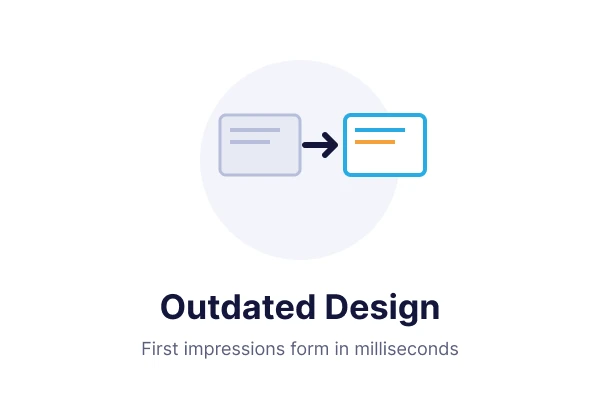
Studies on first impressions consistently show that users form an opinion about a website’s credibility within milliseconds of landing on it, largely based on visual design alone. If your site looks outdated, visitors may unconsciously assume your business is outdated too – even if that’s not true at all.
Signs your design has fallen behind:
- Visual styles, fonts, or colour schemes that feel dated
- Stock photography that looks generic or disconnected from your brand
- Inconsistent spacing, alignment, or typography across pages
- A layout that doesn’t reflect current design standards (cluttered, overly busy, or cramped)
The fix: A redesign is your opportunity to modernise not just the look of your site, but the way it communicates your brand. This goes beyond a fresh coat of paint – it’s about aligning your visual identity with where your business is today, not where it was when the site was first built.
5. Low Conversion Rate
A low conversion rate is the most business-critical sign a website needs a redesign – it means visitors are arriving but not becoming leads or customers, pointing to underlying issues with calls-to-action, trust signals, form friction, or a disconnect between what brought the visitor and what they find on the page.
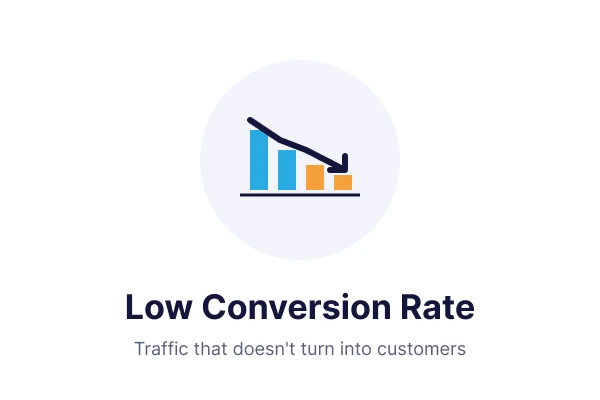
This is the sign that matters most, because it’s the one tied directly to revenue. You can have fast load times, clean navigation, and a beautiful design – but if visitors aren’t converting into leads, sign-ups, or customers, something in the experience is still broken.
A low conversion rate often points to deeper issues, such as:
- Unclear or missing calls-to-action
- Too much friction in forms or checkout flows
- A lack of trust signals (testimonials, reviews, security badges)
- Messaging that doesn’t clearly explain the value of what you’re offering
- A disconnect between what brought the visitor to the site and what they find once they arrive
The fix: A redesign focused on conversion isn’t just about appearance – it’s about strategically guiding visitors toward a clear next step. This is where design, SEO, and sales and marketing automation need to work together, so the site isn’t just attracting traffic but actually converting it into business results.
How Many of These Apply to Your Website?
If your site shows even one or two of these signs, it’s worth a closer look. If it shows three or more, it’s likely actively working against your business goals rather than supporting them.
The good news is that a redesign doesn’t have to mean starting from zero. In most cases, it means strategically rebuilding the parts that are holding you back while keeping what’s already working – your content, your brand identity, your existing traffic and SEO equity.
Frequently Asked Questions
-
How do I know if my website needs a full redesign or just minor updates?
If your issues are limited to outdated content or small visual tweaks, updates may be enough. But if your site is slow, hard to navigate, not mobile-friendly, or has a consistently low conversion rate, those are structural problems that usually require a full redesign rather than a patch.
-
How often should a business redesign its website?
As a general guideline, most businesses should reassess their website every 2–3 years, since design trends, technology, and user expectations shift quickly. That said, performance issues like slow speed or poor mobile experience should be addressed as soon as they’re identified, regardless of how recently the site was built.
-
Will a website redesign hurt my existing SEO rankings?
Not if it’s done correctly. A well-planned redesign – done with proper URL mapping, redirects, and technical SEO in place – typically improves rankings over time rather than hurting them, especially when it resolves speed and mobile usability issues that search engines actively factor into rankings.
-
How long does a website redesign typically take?
Timelines vary based on the size and complexity of the site, but most business website redesigns take anywhere from a few weeks to a couple of months, covering discovery, design, development, content migration, and testing before launch.
-
How much does a website redesign cost?
Cost depends on scope, complexity, and the agency involved. The right framing is as an investment in every future visitor rather than a one-time expense – a redesign that improves speed, mobile usability, and conversion rate pays for itself through better business results. Talk to our team for an accurate scoping and estimate.
-
Does poor mobile design affect Google rankings?
Yes. Google uses mobile-first indexing, which means the mobile version of your site determines your search rankings. Broken layouts, hard-to-tap elements, and slow mobile load times all negatively affect where your site appears in search results – making mobile design a direct SEO issue, not just a UX concern.
Ready for a Website That Works as Hard as You Do?
A website redesign isn’t an expense – it’s an investment in every visitor who lands on your site from this point forward. If you recognised your business in two or more of the signs above, it’s worth a conversation.
Talk to our team about what a redesign could do for your page speed, your user experience, and your conversion rate.
