
Multilingual Website SEO in 2026: Why They’re an SEO Goldmine (And How AI Translation Makes It Easy)
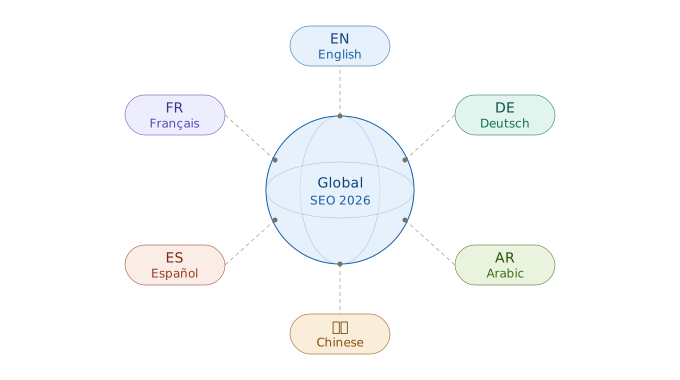
Imagine someone in Paris searching Google for exactly the product you sell. They type their query in French. Google scans billions of pages and picks the most relevant, authoritative sources – in French. Your website, despite having the perfect answer, doesn’t show up. Why? Because it only speaks English.
That’s not a hypothetical anymore. It’s the silent reason millions of websites miss out on global traffic every single day. And in 2026, with AI-powered search engines, voice assistants, and a more multilingual internet than ever before, this gap is wider than it has ever been.
Here’s the good news: building a multilingual website is no longer the months-long, budget-draining project it used to be. AI translation technology has changed the economics entirely. In this guide, we’ll break down exactly why multilingual SEO matters in 2026, what it technically requires, and how a well-built AI translation plugin can open global doors for almost any website.
What Is a Multilingual Website – And Why Does It Matter?
A multilingual website serves the same content in more than one language. But let’s be clear: a truly effective multilingual site is not just your English pages run through Google Translate. That approach actually hurts you – both in user experience and in rankings.
A real multilingual website includes language-specific URLs (like yoursite.com/fr/ for French visitors), properly translated metadata including page titles and descriptions, culturally adapted content that resonates with local audiences, and the correct technical signals that tell search engines exactly what you’re doing.
Done right, a multilingual website is one of the highest-ROI investments in digital marketing. Done wrong, it can create duplicate content penalties and confused search crawlers. The difference comes down to execution – which is exactly what we’ll cover.
Why Multilingual Websites Are an SEO Goldmine in 2026
1. Every Language Is a New Opportunity to Rank
Think of each language version of your website as a separate expansion into a new market. When you publish a French version of your blog post, you’re not just translating – you’re creating a new page eligible to rank for French-language search queries. Add Spanish and you’ve opened another channel. Add German, and another.
Less than 5% of the world’s population are native English speakers, yet the vast majority of websites speak only English. That imbalance is your opportunity.
2. AI Search and Voice Search Are Multilingual by Default
This is the shift that makes 2026 different from even two years ago. AI-powered search engines – including Google’s AI Overviews, Perplexity, and Bing Copilot – now generate answers in the user’s native language and pull from authoritative sources in that same language to back them up.
If a user in Brazil asks a question in Portuguese, AI search looks for credible, well-structured content in Portuguese to cite. If your website only exists in English, you are completely invisible to that query, regardless of how good your content is. Your multilingual presence determines whether you get cited by AI search – or left out entirely.
Voice search follows the same logic. People speak to their devices in their native tongue, using local phrases and regional expressions. Multilingual SEO is the only way to capture that audience.
3. Global Brand Authority and Entity Recognition
Google increasingly evaluates websites as entities – brands with a track record, a reputation, and measurable authority. A website that consistently serves high-quality content across multiple languages signals to search algorithms that it’s a serious, internationally recognized brand. This entity-level trust compounds over time, building a competitive moat that’s difficult for monolingual competitors to overcome.
4. Better User Experience Means Better Rankings
When a visitor lands on a page written in their own language, they stay longer, engage more, and leave with a better impression. Google tracks these behavioral signals – time on page, scroll depth, bounce rate, return visits – and uses them as ranking factors.
A multilingual website creates a naturally better experience for international visitors. That improvement in engagement directly feeds back into improved rankings. It’s a virtuous cycle that pays dividends long-term.
5. Localization Drives Conversions, Not Just Traffic
There’s a powerful commercial argument beyond the SEO benefits. Users are significantly more likely to complete a purchase or inquiry form when a website speaks their language. This isn’t just about translation – it’s about trust. A checkout page in someone’s native language, using their currency and culturally familiar phrasing, removes friction and builds confidence. For e-commerce and SaaS businesses, this effect alone can justify the investment.
6. First-Mover Advantage in Fast-Growing Markets
Markets like Southeast Asia, Latin America, the Middle East, and Sub-Saharan Africa are experiencing rapid internet growth – and most websites serving these regions are still primarily in English, or offer machine-translated content that’s clearly low quality. A well-localized website can establish a dominant position in these markets before competition catches up.
The Technical Side of Multilingual Website SEO You Can’t Afford to Skip

Getting multilingual website SEO right isn’t just about publishing translated text. There’s a technical layer that most businesses get wrong – and getting it wrong can undo all the benefit.
hreflang tags are the most critical element. These HTML attributes tell search engines which language version of a page to show to which user. Nearly 70% of multilingual websites have hreflang errors, causing their content to be mismatched with the wrong audiences or simply ignored by search crawlers.
URL structure matters more than most people realize. The best practice is to use subdirectory-based URLs – yoursite.com/fr/ for French, yoursite.com/es/ for Spanish. This keeps your domain authority concentrated in one place while clearly communicating language to search engines and users alike.
Translated metadata is non-negotiable. Every SEO element must be translated: page titles, meta descriptions, image alt-text, Open Graph tags, and structured data (schema markup). Many websites translate their page content but forget metadata, which means search engines still surface their pages with English titles in French search results – a jarring, conversion-killing experience.
Canonical tags and XML sitemaps round out the technical requirements. Each language version needs its own canonical URL to avoid duplicate content signals, and your sitemap should list all language variants so search engines can efficiently discover and index every page.
These requirements aren’t optional. They’re the difference between a multilingual website that ranks and one that creates more problems than it solves.
Where AI Translation Plugins Change the Game
| Criteria | Basic Machine | AI-Powered Plugin | Human Translator |
|---|---|---|---|
| Speed | Instant | Instant | Days / Weeks |
| Cost | Free | Low cost | High cost |
| SEO-aware | No | Yes | Yes |
| Cultural context | None | Good | Excellent |
| Scalability | Unlimited | Unlimited | Limited |
| Output quality | Poor | High | Highest |
Until recently, building a proper multilingual website meant choosing between two frustrating options: hire professional translators (slow and expensive) or use basic machine translation (fast but low quality, and terrible for SEO).
AI translation has created a third path – and it’s not a compromise. It’s a genuine upgrade.
Modern AI translation, powered by large language models, produces fluent, contextual translations that go far beyond word-for-word conversion. More importantly for our purposes, it can be built to understand SEO – preserving keyword intent, translating slugs and metadata correctly, and handling the technical elements that basic machine translation completely ignores.
For a WordPress site owner or Shopify merchant, an AI translation plugin can mean going from one market to twenty without hiring a single translator – and without producing the kind of stilted, obviously automated content that damages trust and hurts rankings.
The real competitive opportunity isn’t in building just another translation plugin. It’s in building an SEO-first, culturally intelligent translation plugin – one that solves the entire multilingual SEO workflow, not just the words on the page.
What Makes an AI Translation Plugin Stand Out
Not all AI translation plugins are equal. Here’s what separates the tools that actually move the SEO needle from the ones that just move text:
SEO-aware translation goes beyond the page body. It translates page titles, meta descriptions, image alt-text, URL slugs, and schema markup – the elements that most plugins miss but search engines rely on most heavily.
Automatic hreflang generation is a killer feature. Given that the majority of multilingual sites have hreflang errors, a plugin that generates these tags correctly and automatically removes one of the biggest technical barriers to multilingual SEO success.
Brand and glossary protection keeps your product names, trademarks, and technical terms exactly as they should be – not mangled by overeager AI translation.
Cultural localization adapts more than words. The best plugins adjust tone, idiomatic expressions, and cultural references to fit the target audience, not just the target language.
Auto-sync on content updates ensures that when you update your source content, all language versions update automatically – keeping your multilingual site consistent without manual maintenance overhead.
CMS integrations that work seamlessly with WordPress, Shopify, Webflow, and other major platforms remove the technical friction that stops most website owners from going multilingual in the first place.
Real Businesses Already Winning With Multilingual Website SEO
The opportunity isn’t theoretical. An e-commerce brand that adds Spanish and Portuguese product pages can unlock the entire Latin American market – over 600 million potential customers – from content they already own. A SaaS company that translates its landing page into Japanese, German, and French can see significant increases in trial signups from those markets, simply by no longer being invisible to them.
Content sites and blogs that publish in multiple languages can compound their traffic growth rapidly, with each language version building independent authority in its respective market. Even local service businesses – law firms, clinics, agencies in multicultural cities – benefit enormously from offering content in the native languages of their community.
The common thread: these businesses didn’t build new products or services. They made existing ones visible to people who were already looking.
The Bottom Line: Going Multilingual Is a Strategy, Not a Project
In 2026, a multilingual website is not a nice-to-have for global ambitions. It’s a fundamental SEO strategy for any business that wants to grow beyond a single language market – which, given the direction of AI search, voice search, and internet growth globally, is increasingly every business.
The technical barriers are lower than they’ve ever been. AI translation has made quality, scalable multilingual content genuinely accessible. The competitive window is open right now, before most businesses in any given niche catch on.
The question isn’t whether to go multilingual. It’s how fast you can get there – and whether you have the right tools to do it properly.
