
How to Successfully Grow Your Business Online
If you’ve been struggling to grow your business online, you’re not alone – and you’re probably not making the mistakes most people assume.
You’re not failing because you lack a product worth selling. You’re not failing because there’s no demand. In most cases, the businesses that are genuinely stuck in their online growth are stuck because of a single, fixable problem: their digital foundation – the website, the strategy behind it, the technical setup underneath it – isn’t built to help them grow your business online.
The good news is that this is one of the most solvable problems in business. When the right strategy, the right design, and the right development all come together, the shift in results is measurable, often dramatic, and relatively fast.
This article walks through exactly what it takes to grow your business online – what foundation to build, what to look for in a web development partner, and what real growth looks like once it’s in place.
Quick Answer
To grow your business online, you need a website built to rank in search, convert visitors into leads, and perform under real conditions – backed by a web development partner who treats outcomes, not just deliverables, as the goal.
Why Most Businesses Struggle to Grow Online
Most businesses struggle to grow online because their website has structural problems – it doesn’t rank, doesn’t convert, and doesn’t connect to their sales systems – not because they lack demand or marketing budget.
Before getting into solutions, it’s worth being honest about the problem – because the real reason most businesses struggle to grow online isn’t the one they usually identify.
The assumption is usually that it’s a marketing problem. Not enough ad spend. Not enough social media activity. Not enough content. So the response is to pour more into the top of the funnel – more posts, more ads, more traffic.
But if the website those efforts are pointing to has fundamental problems, more traffic just means more wasted budget. You’re filling a leaky bucket.
A web development partner is an agency or team that combines strategy, design, technical development, and ongoing optimization to build websites that drive measurable business growth – not just a vendor who delivers pages and moves on.
The actual blockers to online business growth are almost always structural:
The website doesn’t rank. If your potential customers are actively searching for the services you offer and your site isn’t appearing, they’re finding someone else. This isn’t a content problem – it’s a technical and strategic SEO problem that starts at the development stage.
The website doesn’t convert. Traffic that doesn’t turn into leads or sales is just a vanity metric. A website that attracts visitors but gives them no clear reason to reach out, no easy way to take the next step, and no compelling reason to trust you is actively losing business every single day.
The website doesn’t perform. Slow load times, broken mobile experiences, and poor Core Web Vitals scores don’t just frustrate users – they directly impact search rankings. Google uses performance signals as part of how it decides which sites deserve to rank.
The website doesn’t connect. A site that operates in isolation from your social presence, email marketing, CRM, and sales process gives you nothing to measure. And what you can’t measure, you can’t improve.
None of these are design problems. They’re strategy and engineering problems. And they require a solution that starts with strategy and engineering.
What “Growing Your Business Online” Actually Requires
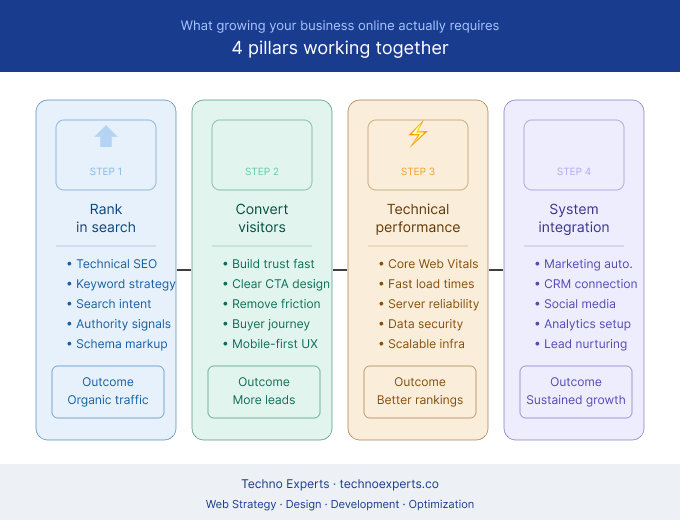
Growing your business online requires four things working together: a website built to rank in search, a conversion-optimized design, technical performance that holds up under real conditions, and integration with your broader sales and marketing systems.
Genuine online business growth isn’t magic and it isn’t luck. It’s the outcome of getting a clear sequence of things right, in the right order, with the right people.
Step 1: Build Your Digital Presence to Grow Your Business Online
The starting point for sustainable online growth is organic visibility. Paid traffic has its place, but a business that depends entirely on ads for its online leads is one budget cut away from losing all of them. Organic search – showing up when people search for what you offer – is the kind of traffic that compounds over time.
Building a website that ranks means getting several layers right simultaneously:
- Technical SEO baked in from the start – clean site structure, fast load times, proper indexing, mobile-first design
- Keyword strategy that maps to real search intent – not just targeting keywords people search for, but targeting keywords that signal buying intent, not just curiosity
- Content that answers the questions your audience is actually asking – in language that’s clear and direct, not stuffed with keywords that nobody actually uses
- Authority signals that tell search engines your site is trustworthy – through internal linking, external references, schema markup, and backlinks earned over time
This is the foundation layer. Everything else is built on top of it. Our SEO services are designed with this in mind from day one, not bolted on as an afterthought once the site is live.
Step 2: A Website That Actually Converts Visitors Into Leads
Once you have people coming to the site as you work to grow your business online, the next job is converting them. This is where design and development have to work together as one system, not two separate workstreams.
A high-converting website does several things simultaneously:
It builds trust quickly. Most visitors decide whether to keep reading within the first few seconds. If the design looks dated, the messaging is vague, or the page loads slowly, they leave – and most don’t come back. Good design is partly aesthetic and mostly functional. It builds credibility, communicates relevance, and keeps people engaged long enough to make a decision.
It makes the next step obvious. Every page should have one clear action you want the visitor to take. Not three options. Not buried links. One obvious call to action, positioned where visitors naturally look, with copy that makes taking that step feel worth it.
It removes friction. The number one conversion killer is making things harder than they need to be. Forms with too many fields. Contact pages that are hard to find. Mobile layouts where nothing is tappable. Every point of friction in the user journey is a percentage of leads you’ll never hear from.
It speaks to the right person at the right stage. Not every visitor is ready to buy immediately. A well-built website addresses visitors at different stages – those just researching, those actively comparing options, and those ready to make a decision – and gives each group a reason to take the appropriate next step.
Our approach to website design and website development treats conversion as an engineering challenge, not a design preference.
Step 3: Performance That Holds Up Under Real Conditions
A beautiful, strategically designed website that falls apart technically is still a failed investment. Performance isn’t optional – it’s a direct driver of both user experience and search rankings.
The metrics that matter most are the ones Google measures under its Core Web Vitals framework: how fast the page becomes usable, how stable the layout is while loading, and how quickly the site responds to user interaction. Sites that perform well on these metrics rank better, retain visitors longer, and convert at higher rates.
Beyond speed, performance also means:
- Reliability – the site stays up and loads consistently, handled through proper server setup and management
- Security – customer data and business information are protected through built-in data security and protection measures, not reactive patching
- Scalability – the infrastructure can handle growth in traffic without degrading, so the site that works for 100 visitors a month also works for 10,000
Step 4: Integration With the Rest of Your Growth System
A website that works in isolation is only doing part of its job. Sustainable online growth comes when the website is fully integrated with the systems around it.
That means connecting your site to sales and marketing automation so that leads captured on the site flow into nurture sequences automatically. It means aligning your social media marketing so that the audiences you build across platforms are funnelled back toward a site that can convert them. And it means building in analytics and tracking from the start so that every improvement is data-informed rather than guesswork.
What Real Results Look Like: The Numbers That Matter
The difference between a strong web development partner and an average one shows up clearly when you’re trying to grow your business online – and the outcomes reflect it.
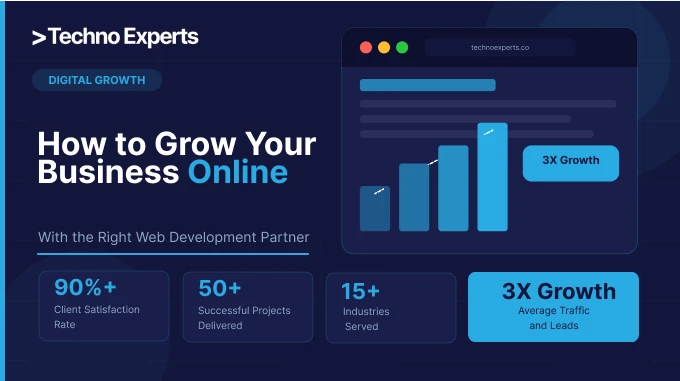
90%+ Client Satisfaction Rate. Not because every project is easy, but because clear communication, realistic timelines, and genuine commitment to outcomes make the difference between a frustrating agency experience and a productive one.
50+ Successful Projects Delivered. Across industries, business sizes, and levels of digital maturity. The experience of having solved similar problems before – and knowing what actually works versus what just sounds good in a proposal – is genuinely valuable.
15+ Industries Served. Including retail, healthcare, education, hospitality, real estate, professional services, and technology. Different industries have different audiences, different conversion patterns, and different SEO landscapes. That breadth of experience means we bring relevant context to every project, not generic solutions.
3X Average Growth in Traffic & Leads. This is the outcome metric that matters most, and it’s the one we’re most proud of. Traffic and leads are the signals that a site is doing its job – that the strategy is working, the performance is holding up, and the conversion design is guiding visitors in the right direction.
These numbers aren’t marketing claims. They’re the downstream result of consistently getting strategy, design, development, and optimization right – and of caring about outcomes rather than just deliverables – which is what it truly takes to grow your business online sustainably.
How to Choose the Right Web Development Partner to Grow Your Business Online
The right web development partner asks about your business goals before talking about design, shows real post-launch results (not just screenshots), and thinks beyond the launch date to long-term growth.
Not every web development agency is the right fit for every business. Here’s what to look for when you’re evaluating partners:
They ask about your business goals before talking about design. A partner who leads with aesthetics and templates before understanding what you need the site to achieve is going to build something that looks good and performs poorly.
They talk about strategy and performance, not just deliverables. The question isn’t just “what pages will the site have?” – it’s “how will this site rank, convert, and generate leads?”
They can show you real results from real clients. Not just screenshots of finished sites, but data on what happened after launch. Traffic growth. Lead volume. Conversion rates. Measurable outcomes.
They’re transparent about timelines, process, and what they need from you. A website project is always a collaboration. The best partners are clear about what they’ll deliver, when, and what they need from your side to make it happen.
They think beyond launch. A one-and-done agency builds the site and moves on. A real partner thinks about what happens after launch – how the site will be optimized, maintained, and evolved as the business grows.
From Struggling to Scaling: How to Grow Your Business Online
If your business is currently struggling to grow online, the path forward isn’t another ad campaign. It’s a website built with the right strategy behind it, optimized to perform under real conditions, designed to convert visitors into customers, and connected to the systems that sustain growth over time.
That’s not a complicated formula. But it requires getting all the pieces right and having a partner who takes the outcome as seriously as you do.
At Techno Experts, this is all we do. Strategy. Design. Development. Optimization. Growth. And for businesses ready to reach new markets, tools like AI Language Translation that extend reach without adding overhead.
Frequently Asked Questions
How long does it take to start seeing results after a new website launch?
Most businesses start seeing measurable improvements in organic traffic within 2–4 months of a well-optimized launch, with consistent growth building from there. Conversion and lead improvements typically appear faster – often within the first few weeks – because they reflect the site’s structural changes rather than search engine indexing cycles.
Do I need to rebuild my entire website or can parts of it be improved?
Not every business needs a full rebuild. In some cases, targeted improvements – better conversion design on key pages, technical SEO fixes, performance optimization – deliver strong results without starting from scratch. We always start with a clear diagnosis before recommending a scope of work.
What’s the most important thing to get right on a business website?
If forced to pick one: clarity. Visitors need to understand what you do, who it’s for, and what to do next within seconds of landing on your site. All the technical optimization in the world won’t save a site that confuses visitors about its purpose.
How do you help businesses that serve multiple markets or languages?
For businesses expanding into new regions, we integrate language solutions – including AI-powered translation – so the site can serve international audiences without requiring a completely separate build. We also handle the technical SEO considerations that come with multilingual sites, such as hreflang tags and localized content structure.
What ongoing support do you provide after a website launches?
We offer ongoing support across performance monitoring, SEO, content updates, security, and infrastructure. The goal is to be a long-term partner in growth, not a vendor who disappears at handoff.
Ready to Grow? Let’s Build Something Great Together.
From strategy to execution – from the first conversation to the moment your site starts generating real leads – we’re here for every step of it.
If you’re ready to stop settling for a website that just exists and start building one that helps you grow your business online, the next step is simple.
Talk to our team today – no obligation, no hard sell. Just a straightforward conversation about what your business needs and how we can help deliver it.
